www.warwalker.co.uk
Ypres Salient | Artois | Verdun | FR/US Frontline | The Somme | Hindenburg Line ||| Maginot Line | Normandy | Arnhem
Home

Tracing Military Ancestors
Travel Advice
CWGC Cemeteries
Iron Harvest
News
Book Reviews
Links
Contact Me

Battlefields:
World War One
- Ypres Salient
- Artois
- Verdun
- FR/US Frontline
- The Somme
- Hindenburg Line

World War Two
- The Maginot Line
- Normandy
- Arnhem

Evrsoft - Website Builder Tools

Streamline.Net The home of good value web hosting

Getting There

There are three main ways of reaching the First and Second World War battlefields of north-western Europe:

i) Car Ferry
This is still my favourite mode of transport to the battlefields. Although slower in actual crossing time than Eurotunnel, it always seems to be quicker in loading and unloading and the wonderful views of the White Cliffs and the French coast always make you feel that it’s part of the holiday rather than just the journey there.

Dover to Calais – The most popular ferry route and almost certainly the quickest wherever you live in the UK to destinations along the old Western Front like the Ypres Salient, the Artois battlefields, the Somme, the Champagne battlefields and Verdun. There are numerous sailings to choose from and, in the 2007 season, prices are becoming quite competitive – although you should book early for the best rates. For further information the following companies run services on this route:

P&O Ferries at www.poferries.com/tourist/
Sea France www.seafrance.com/seafrance/opencms/uk/en/passenger/

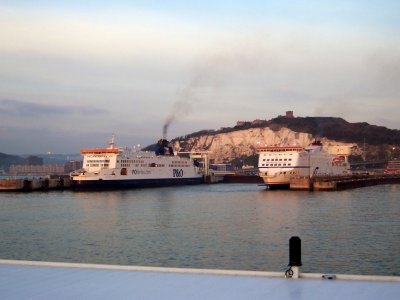
Ferries at Dover
Photo: Mark Sluman.

Dover to Dunkerque – If you’re visiting sites in northern Belgium (or the Dunkerque beaches themselves) you may want to consider using Norfolk Line services from Dover direct to Dunkerque. Because of the increased sailing time and the closeness of Calais by road (just 25 minutes away), there’s probably not a lot in it if you’re looking to travel to the Ypres Salient and, of course, there’s less choice of sailings. For further information, visit www.norfolkline-ferries.co.uk/en/dd-passenger.

Dover to Boulogne – A relative newcomer to cross-channel services, SpeedFerries is the only operator to use this route. However, if you’re looking to go to the Normandy beaches or straight down to the Somme region this is a really good alternative. The main advantage is the speed of the service – the SeaCat completes the journey in just under an hour in good conditions. However, there are fewer sailings to choose from and, unlike Calais, Boulogne can be a very confusing town to find your way out of. For further information, visit www.speedferries.com.

(Note: As of 29 March 2007, SpeedFerries have changed their embarkation point to Dover Western Docks, known as the Hoverport.)

UPDATE: As of mid-November 2008, SpeedFerries has gone into administration. Sailings for 14, 15, 16, 17 and 18 November 2008 have already been cancelled. Customers are asked to wait for further information on future crossings and to keep any pre-booked tickets. Latest information is contained on the website link above.

Newhaven to Dieppe – Transmanche Ferries have now started sailings on this route – the SeaCat having departed a couple of years ago. However, at four hours crossing time this will probably only benefit those living in East Sussex if they’re thinking of touring the direct vicinity of Dieppe or travelling down to Normandy. For further information, visit www.transmancheferries.com.

Portsmouth or Newhaven to Le Havre – LD Lines have just commenced sailings on this route. Unfortunately, journey times are long and sailings few. However, as the sailings run overnight, those prepared to forego some sleep may find this a useful way of maximising time spent exploring. For further information, visit www.ldlines.co.uk.

Portsmouth to Normandy – For those living in the Midlands, Wales, central South or South-West of the UK this route is a potential alternative if you want to explore the Normandy beaches and battlefields. Brittany Ferries run services into Ouistreham (Caen’s port) and Cherbourg. Ferry journey times are long but SeaCats now operate on both routes with journey times of 3 ¾ and 3 hours respectively. For further information, visit www.brittanyferries.co.uk.

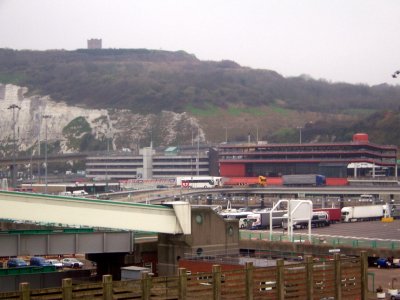
Dover Eastern Docks
Dover Eastern Docks. Photo: Mark Sluman.

ii) Eurotunnel
The quickest way to get to the Continent in terms of journey time, although loading, unloading and passport control can seem to drag and facilities are fairly limited once you’re on the train. Of course, sitting in your car inside a speeding metal box inside a concrete tube isn’t everyone’s idea of travel and, if you suffer even remotely from claustrophobia, you’ll be yearning for the open deck, shopping and restaurant areas of the ferries sailing several hundred feet above you!

Embarkation is at Folkestone – the entrance to the terminal being well signposted from the M20 motorway. For further information about Eurotunnel visit www.eurotunnel.com.

iii) Eurostar
The passenger equivalent of Eurotunnel, Eurostar provides an interesting alternative to taking your car. Terminals at London Waterloo and Ashford International whisk passengers to Calais, Lille, Paris and Brussels in a couple of hours. On the way back, if you upgrade to first-class, you can view the beautiful French and Belgian countryside with a glass of champagne in your hand and a delicious three-course meal to look forward to – an ideal end to a battlefield tour. This method of travel is a really good option if you’re looking to visit the battlefields of Operation Market Garden in Holland. The Dutch railway system is superb and the train can easily reach most locations. Hire a bicycle and you’re away! Change at Brussels Sud for trains to Amsterdam. For further information about Eurostar, visit www.eurostar.com/dynamic/index.jsp.